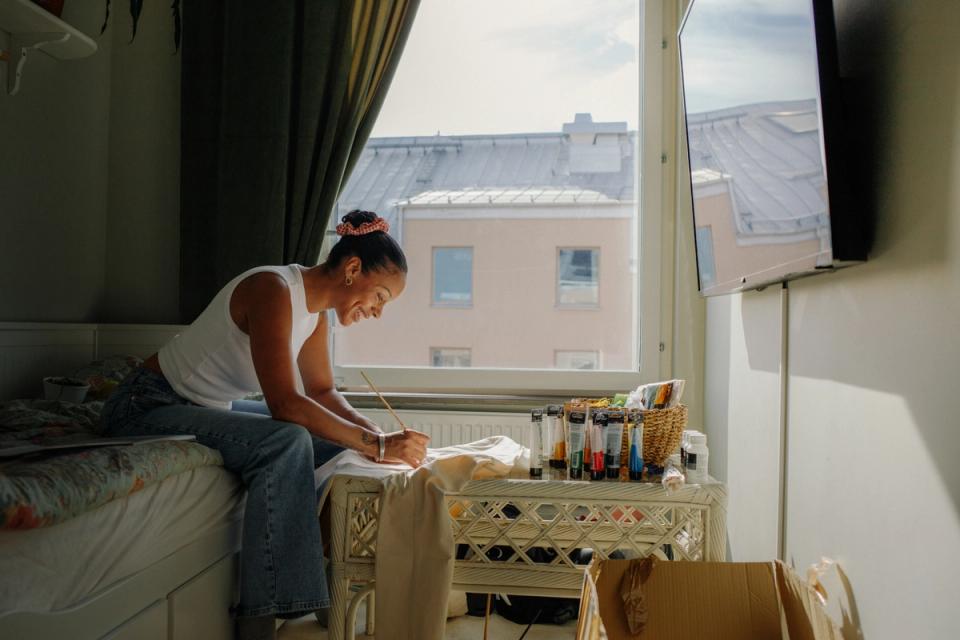
Rugiyatou Jallow paints on overshirts during Stockholm Art Week 2026
A Day's March and Mack Art Foundation present Rugiyatou Ylva Jallow (b. 1990, Stockholm), a Swedish-Gambian visual artist based in Los Angeles. Working primarily in acrylic and oil, her practice centers around expressive self-portraiture and an intuitive, process-driven approach.
Her work explores themes of identity, belonging, and emotional distance, shaped by the experience of navigating multiple cultural contexts. Through layered compositions, forms emerge through gesture, repetition, and transformation.
The collection will be available during Stockholm Art Week at A Day’s March, Kungsgatan 3, Stockholm, April 21–26.
What happens when a garment becomes a surface for memory, gesture, and presence?
During Stockholm Art Week 2026, A Day’s March and Mack Art Foundation present a collaboration with artist Rugiyatou Jallow – a series of hand-painted garments and a limited-edition silk scarf, shaped through an intuitive, personal process.
Born in Stockholm and now based in Los Angeles, Jallow is known for her expressive, often self-portrait-based paintings. Her work explores identity, belonging, and emotional distance, shaped by navigating multiple cultural contexts. Through layered compositions, forms emerge and dissolve through gesture and repetition.
Here, that language is translated into clothing.
Working directly onto a selection of white overshirts, Jallow approaches each piece as an extension of her painterly process, where texture, rhythm, and subtle shifts in tone become central. Each garment is shaped through presence rather than repetition – resulting in singular pieces.
Alongside the overshirts, a silk scarf presents Förenade i ängens ande (2026), extending her work into a format that can be worn, carried, and returned to over time.
The collaboration continues an ongoing exploration by A Day’s March and Mack Art Foundation – bringing art beyond traditional spaces and into everyday life.
“For us, this collaboration is about opening up that space,” says Rasmus Elfton. “Allowing art to exist somewhere else – and exploring the grey area of what these pieces are.”
What emerges is a collection that exists between disciplines – not fully art, not fully clothing, but something in between
“A painting holds gestures and decisions; a garment holds lived experience.”
What role does clothing play in how you express yourself?
Clothing is an extension of my practice. In the same way I build a painting through layers, texture, and subtle shifts in tone, I approach dressing as a composition. I tend to gravitate toward minimal silhouettes and earth tones, but I’m always attentive to small details – how a seam falls, how a fabric moves, how something sits on the body. Getting dressed feels like preparing a surface. It’s a quiet, daily ritual of shaping how I want to move through the world – not in a performative way, but as a form of alignment between my internal state and what I present externally.
Do you think garments can hold memory or identity in the same way that art does?
Absolutely. I think garments absorb the body over time – the way they’re worn, repeated, carried through different moments. They hold traces of movement, environment, and emotional states, even if subtly. In that sense, they’re not so different from paintings. Both can act as vessels. A painting holds gestures and decisions; a garment holds lived experience. Over time, they both accumulate meaning beyond their original form.
Do you see style as a form of storytelling? If so, what kind of stories do you tell through what you wear?
I do, but the storytelling is subtle. It’s less about a narrative you can immediately read, and more about a feeling that lingers. The way I dress reflects a balance between softness and presence – something grounded, calm, but intentional. If there’s a story, it’s one of introspection and self-containment. Someone who doesn’t need to announce themselves loudly to be felt.
“I want the piece to feel like a companion rather than a statement.”
How do you imagine these pieces living on a body, rather than on a wall?
On a body, the work becomes activated in a completely different way. It moves, it breathes, and enters real environments. It’s no longer something to be observed at a distance – it becomes part of someone’s daily rhythm. I think about how the imagery and materials shift with movement, posture, light, and the pace of someone’s day. There’s something intimate about that. The work is no longer static – it becomes relational.
What do you hope someone carries with them when they wear one of your pieces?
I want the piece to feel like a companion rather than a statement – something that doesn’t overpower, but instead brings the relationship between the person and the art closer.
Each overshirt in the collection has been individually hand-painted by Rugiyatou Jallow using textile pigment.
Variations, marks, and irregularities are part of the work. The silk scarf features a printed artwork by the artist, Förenade i ängens ande (2026).
Scarf
Scarf
Overshirt #1 - Front
Overshirt #1 - Back
Overshirt #2 - Front
Overshirt #2 - Back
Overshirt #3 - Front
Overshirt 3# - Back
Overshirt #4 - Front
Overshirt #4 - Back
Overshirt #5 - Front
Overshirt #5 - Back
Overshirt #6 - Front
Overshirt #6 - Back
Overshirt #7 - Front
Overshirt #7 - Back
Overshirt #8 - Front
Overshirt #8 - Back
Overshirt #9 - Front
Overshirt # 9- Back
Overshirt #10 - Front
Overshirt #10 - Back
Overshirt #11 - Front
Overshirt #11 - Back
Overshirt #12 - Front
Overshirt #12 - Back
Overshirt #13 - Front
Overshirt #13 - Back
Overshirt #14 - Front
Overshirt #14 - Back
More overshirts coming...
Shop the Core Collection
Core Collection
We celebrate the Everyday Uniform – understated, versatile, and made for life. The Core Collection reflects A Day’s March’s commitment to daily readiness, quiet confidence, and lasting quality.
The key idea is essentials you return to, day after day. Not because you have to, but because they work.
Explore
A Day's March with Filip & FredrikThe Quarterly: Spring 2026